
Adding Sources and Destinations
Every source and destination has a type dropdown when you add it — pick whichever matches your actual encoder, software, or hardware. This page walks through each one at a glance; for OBS and vMix specifically, see the dedicated step-by-step guides:
- OBS Setup Guide — pushing a source in, and receiving a return/destination feed (Media Source settings).
- vMix Setup Guide — receiving routed slots, and sending a return/program-out feed.
What the dashboard looks like
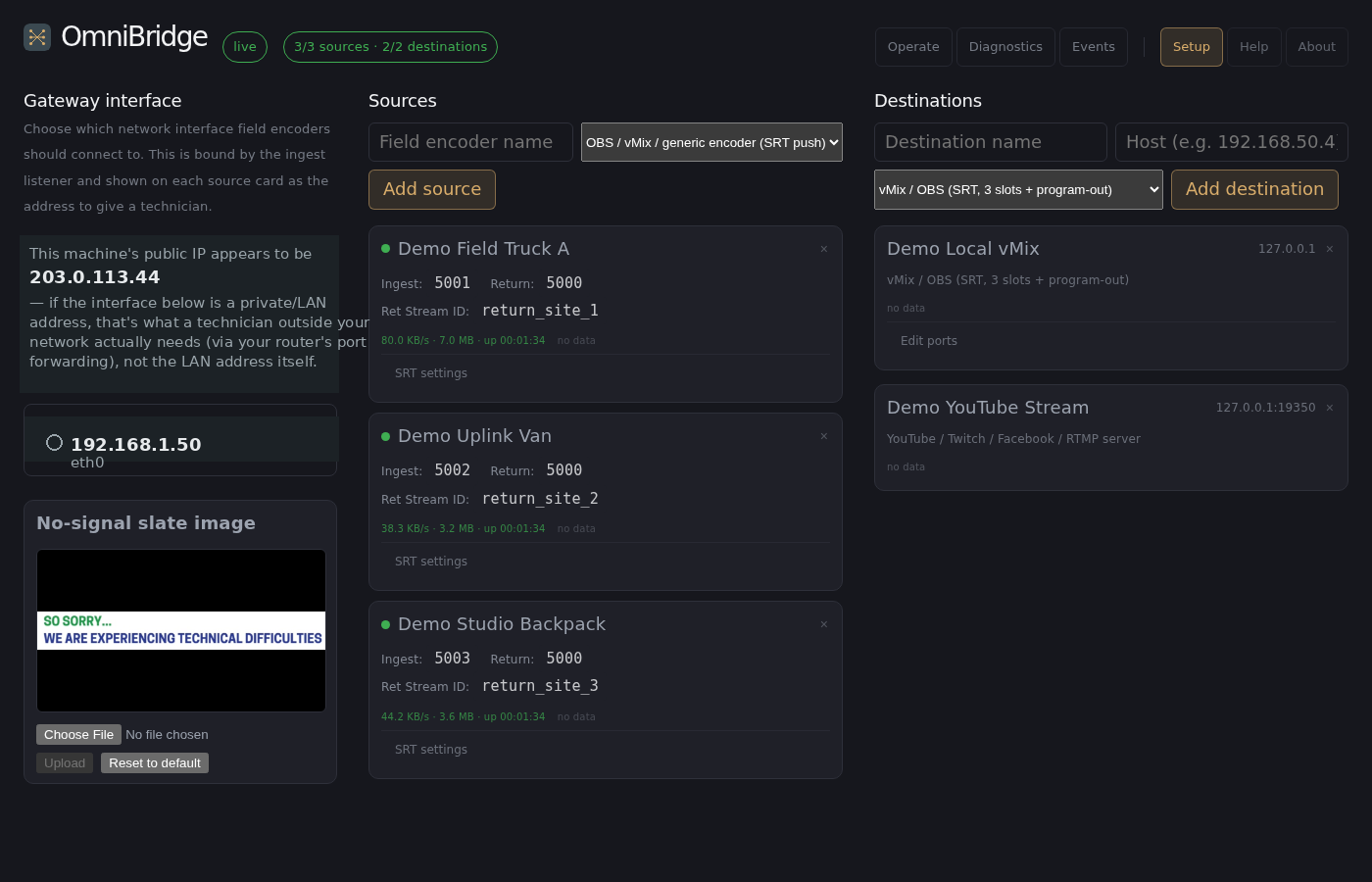
Adding a source or destination happens on the Setup tab — sources on the left, destinations on the right. Each source/destination type is picked from a dropdown naming real hardware/apps, not raw protocol jargon. Every source and destination card shows a live traffic stat (bytes, uptime, bitrate) next to its status dot. SRT-protocol cards also have a toggle for overriding latency, passphrase, or port numbers — called SRT settings on a source's card, Edit ports on a destination's card (same idea, different name depending which side you're on):
Routing lives on its own Operate tab, sized to fill the actual browser window rather than a fixed layout. Every source and destination appears as a tile with a live-ish thumbnail and a color-coded status border (red/yellow/green, same meaning as the status dots described in Ports and Troubleshooting). Two different drags do two different things:
- Drag a source tile onto a destination tile to send that source's feed in — including single-feed destinations (Epiphan, a streaming platform, a RIST box), which route exactly the same drag-and-drop way as a 3-slot vMix/OBS destination.
- Drag a destination's header onto a source's return zone (the small strip below that source's own tile) to send that destination's program-out feed back to the source as a return/preview feed — a separate, optional step most sources never need.
Adding a source (something pushing video in)
On the Setup tab, click Add source, give it a name, and pick its type:
OBS / vMix / generic encoder (SRT push) — the default
Most cameras/encoders and OBS itself default to this. In your encoder's SRT output settings:
- Server / URL:
srt://<gateway-public-ip>:<port> - The port is shown on the source's card once it's created (
5000 +its position number — e.g. the first source added is port5001). - No stream ID, no passphrase, no special latency setting needed by default — the gateway accepts any SRT connection on that port unconditionally.
- Optional: click SRT settings on the source's card to override the gateway's default latency (120ms) or require a passphrase for this specific source — useful for a picky encoder, or if you want to lock down who can push to this source's port. If you set one, your encoder's SRT output needs the matching passphrase or it'll be refused.
- Leave your encoder on its default caller mode. The gateway is always the listener for sources.
See the OBS Setup Guide for the exact OBS dialog.
OBS / generic encoder (RTMP push)
Same idea, but RTMP instead of SRT:
- Server:
rtmp://<gateway-public-ip>:<port> - Stream key / path: shown right on the source's card once it's
created (e.g.
live/site-3) — copy it exactly, a mismatched path is silently rejected.
Hardware encoder (UDP MPEG-TS)
For encoders that only speak raw UDP-TS (no SRT/RTMP option) — common on some older or embedded hardware:
- Point the encoder's UDP output at
<gateway-public-ip>:<port>(unicast, not multicast). - There's no handshake or connection state with plain UDP, so the status dot here reflects "packets arriving in the last couple seconds," not a true connected/disconnected signal.
RIST-capable encoder
- Point the encoder's RIST output (caller mode, not listener) at
rist://<gateway-public-ip>:<port>. - The gateway is the RIST listener, matching every other source type — your encoder should always be the one calling in.
Adding a destination (where video goes out to)
On the Setup tab, click Add destination, give it a name and host/IP, and pick its type.
vMix / OBS (SRT, 3 slots + program-out) — the default
The original vMix-shaped destination: 3 input slots you drag sources onto, plus a program-out feed you can route back to the field or into another destination. See the vMix Setup Guide or OBS Setup Guide for exact steps.
- The gateway always dials out to your destination — nothing needs an inbound firewall rule from the internet, only from the gateway on your local network.
- Two destinations on the same physical box (e.g. OBS and vMix both
running on one PC) will collide on the shared program-out port
(
14000) by default — Edit ports on a destination's card doesn't expose a way to override this specific port per-destination, so today the only fix is running the second instance on a different host/VM, or accepting that only one of the two can have a working program-out on that box.
Epiphan / hardware decoder (UDP MPEG-TS)
A single-feed destination — create it here on Setup, then go to Operate and drag a source (a source tile, or another destination's program-out tile) onto it; the gateway sends whatever's routed there straight out as UDP-TS:
- Set the destination's port to whatever your decoder box is configured to listen on.
- Point the decoder's own UDP input at this gateway's IP and that same port.
YouTube / Twitch / Facebook / RTMP server
- Host: the platform's actual RTMP ingest server (e.g. YouTube's is
typically
a.rtmp.youtube.com, port1935) — check your platform's own streaming dashboard for the current value. - App/stream path: the platform's stream key, exactly as shown in its dashboard (this goes in the "App/stream path" field when adding the destination).
- On the Operate tab, drag the source feeding this destination onto its tile.
RIST decoder appliance
- Set the destination's port to whatever your RIST decoder is listening on, and make sure the decoder is in listener mode — the gateway always calls out as the RIST client here, same direction as every other destination.
A note on reroutes
Changing what feeds a vMix/OBS or UDP-TS destination takes effect instantly with no interruption — that's a live, in-process switch.
Changing what feeds an RTMP or RIST destination causes a brief real interruption (a second or two) — those two protocols are bridged through an external tool that has to restart to pick up a new source. Expect a short glitch on that specific output when you reroute it, even though everything else keeps running normally.